
Ending Evolution: Reflections on a Ted Talk
If I had a list of favorite scientists, Manolis Kellis would be up there with Marie Curie and Einstein. He is thought-provoking and has an infectious optimism. In this month's blog post, I discuss his 2022 Tedx Talk, offering my own experiences and knowledge where I can.
BEGINNER FRIENDLYCOMMENTARY
Sohum Bhardwaj
11/27/20254 min read
Intro
If I had a list of favorite scientists, Manolis Kellis would be up there with Marie Curie and Einstein. He is thought-provoking and has an infectious optimism. A few years ago, he gave a critically underrated Tedx talk at MIT, opening with the line
"We study the products of evolution, so we can help bring an end to evolution as we know it" - Dr. Manolis Kellis
The talk in question is linked here, and I highly suggest you check it out. I won't bore you by simply summarizing it like a reaction channel on YouTube. Instead, I'll try to adopt the approach of the Parsis, and sprinkle in some of my own insights to make the talk even sweeter.
Emergent Properties in Biology
Dr. Kellis opens his talk by pointing out the paradox of life. How does a single cell, with a very limited amount of coding DNA, proliferate into a complex multifaceted living organism?
We can even go deeper, how do atoms, which we all agree are not alive, lead to life. At what point in the number line of complexity does life arise? To me, this is the most interesting question in biology--perhaps all of science. It is even more relevant in our discussions over the sentience of AI.
Scientists who study this have noted many different properties of life and systems that seem to emerge when they get more complex. Often times, these "emergent properties" are many times more complex than the system that underlies them
One example from Campbell's Biology is how cells in our body coordinate a 24-hour sleep-wake schedule. Of course, each individual cell can transduce and transmit signaling molecules, but how do trillions of cells coordinate such a cycle?
Another example is consciousness, which has yet to be truly explained. At what point does a consciousness emerge from a network of connected cells?
Systems biologists, and a lot of other types of scientists, grapple and address these questions which have a profound impact on our understand of ourselves and others. I love that Dr. Kellis touches upon this topic as an example of how complex and mysterious life is to us.
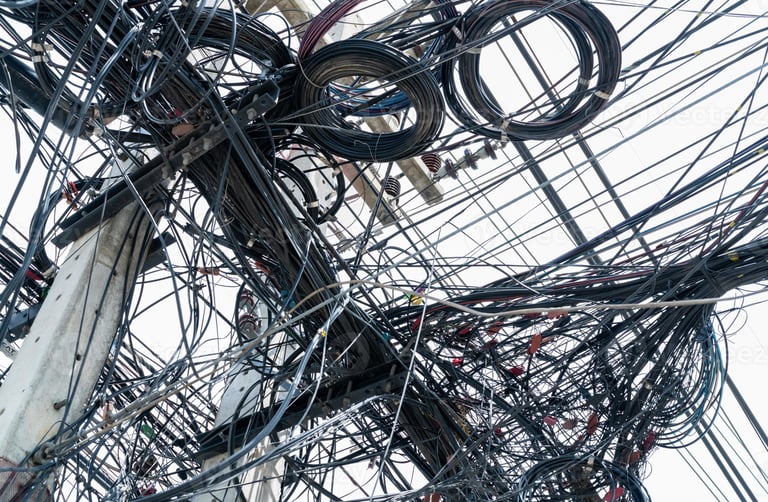
In the talk, Dr. Kellis refers to our genetic circuitry as a bundle of tangle wires. So tangled that not only are they criss-crossed, but they are open and touching each other. This picture, while unsettling, is very true when learning about the systems that dictate our bodies.
Visualizations of Evolution


Each gene, each protein, is interconnected through a web of promoters, transcription factors, feedback loops, and inhibitors.
For example, tyrosine kinase receivers are these proteins that sit on the membrane of almost all of your cells. They come in many different shapes and sizes for different purposes, but their main purpose is to receive signaling molecules and transduce their signals throughout the cell.
However, when a tyrosine kinase activates, it doesn't trigger one pathway, or two pathways. It triggers an average of 10 different cellular pathways. When I first learned about them, I was absolutely stupefied.
10 different pathways, turning on different genes, promoters, or inhibitors to interweave with each other. It is truly a marvel of complexity; any engineer would see this and rip his hair out. It would be impossible to maintain such a monstrous contraption.
In fact, it almost is! An increase in tyrosine kinase complexes is highly correlated with cancer. These messes are simultaneously beautiful marvels of evolutionary engineering and potent failure points that allow cancer and genetic diseases to wreak havoc.
Evolution from a Software Engineering Perspective
Dr. Kellis uses some metaphors to connect computer science and evolution, and listening to it made me realize something. Our internal circuitry is like a really poorly maintained software project.
Almost all modern advice on software engineering praises simplicity and controlling side effects. Which are when running certain parts of code unintentionally affects other parts. While in biology, it seems like these side effects of turning on genes are intentional. The idea of messy decentralized logic remains.
There is no segmentation or virtualization in our DNA circuitry. Completely unrelated parts of our genome can influence themselves in regulatory systems. It is truly a nightmare for any programmer.
Yet despite that, billions of years of trial and error has ensured that it works. If it didn't it wouldn't have been passed down. This is the simplicity of evolution that Dr. Kellis mentions in his talk.
Slow evolution
Evolution is really slow. Dr. Kellis likens it to brute force search where a program attempts to evaluate all possible solutions until it finds the best one.
This has been fine for millennia, but in the modern age, evolution is beginning to show its cracks.
We have an abundance of food, yet our body still retains unhealthy levels of fat. We have access to systems that can hijack the reward system of our brains in ways that are detrimental to our health. Our bodies break down way before we are ready for them to.
In my experience, we compensate with disciplining ourselves and learning from others. We control and guide our instincts in a way that benefits us. Every day we battle against a million years of evolution that tell us to stuff our face with cookies.
The processes I just described are horizontal evolution, evolution through the transmission of knowledge across humanity. Not just from ancestors like the traditional selfish vertical evolution.
Dr. Kellis talks extensively about the shift from vertical to horizontal evolution. As a beacon of hope for our species and for a future where we can be free of our body's idiosyncrasies. It is a message that is optimistic in a time of fear and uncertainty over how technology will displace us and enable bad actors to hurt us. It gives me hope that we can use technology to better humanity as we have for thousands of years!
